The Grand Archives
Explore our collection of 85 board games
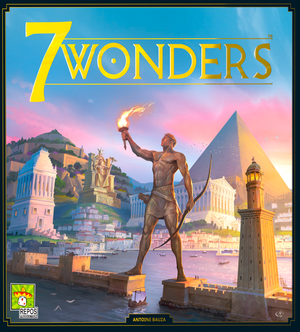
7 Wonder
7 Wonders The board game with more awards than any other game on the planet. With over 30 international awards, and over a million copies sold throughout the world, rediscover 7 Wonders, the game which has won more awards than any other game in the world, in a whole new version. Lauded by both the public and critics, 7 Wonders has claimed its place as an unmissable reference point in modern board gaming. 7 Wonders is based on a simple and elegant mechanic (drafting) which allows up to 7 players to play with no dead time. Players make their choice and apply all of them at the same time. These choices are varied and their impact is real. Finally, the game is divided into 3 Ages which little by little increase the importance of these choices and thus the tension in the game. The global mechanics and the care given to the artwork are used to immerse the player in Antiquity and have contributed to the game’s success. A game plays out over 3 rounds, called Ages, during which you simultaneously play cards, one at a time, to develop your City. These cards represent the various Buildings you can construct: resource producers, civilian, commercial, military, scientific structures, and guilds. At the end of each Age, you go to war with your nearest neighbours. At the end of all 3 Ages, you tally up all of the victory points earned by your City, your wonder, your military prowess, and your treasury. The player with the highest score wins the game.
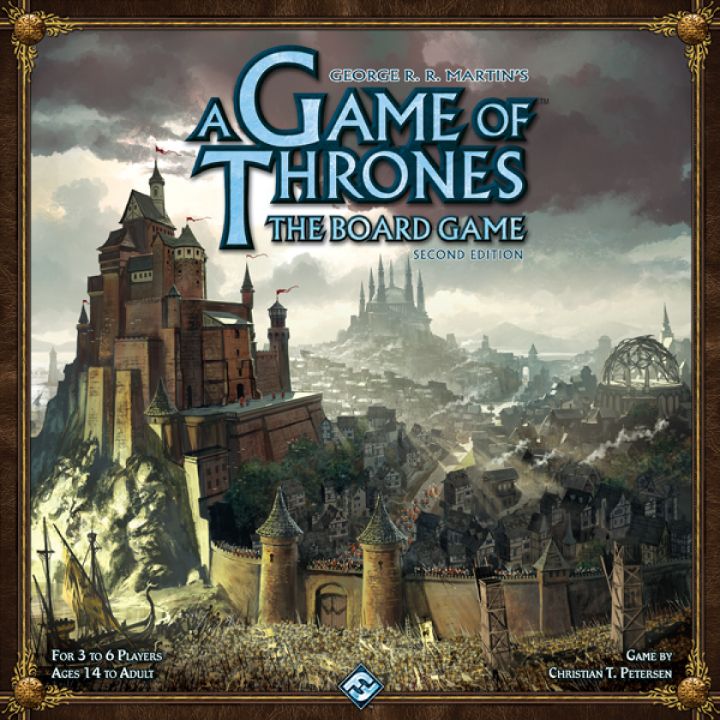
A Game of Thrones: The Board Game (Second Edition)
King Robert Baratheon is dead, and the lands of Westeros brace for battle. In the second edition of A Game of Thrones: The Board Game, three to six players take on the roles of the great Houses of the Seven Kingdoms of Westeros, as they vie for control of the Iron Throne through the use of diplomacy and warfare. Based on the best-selling A Song of Ice and Fire series of fantasy novels by George R.R. Martin, A Game of Thrones is an epic board game in which it will take more than military might to win. Will you take power through force, use honeyed words to coerce your way onto the throne, or rally the townsfolk to your side? Through strategic planning, masterful diplomacy, and clever card play, spread your influence over Westeros! To begin the game, each player receives an army of Footman, Knight, Siege Engine, and Ship units, as well as a set of Order tokens and other necessary components. Each player also receives a deck of unique House Cards, which are used as leaders in battles against rival Houses. Each round in the game is made up of three phases: the Westeros Phase, the Planning Phase, and the Action Phase. The Westeros Phase represents special events and day-to-day activities in Westeros. There are three different Westeros Decks, and each denotes a different global action, potentially affecting all players. The Planning Phase is perhaps the most important. Here you secretly assign orders to all of your units by placing one order token face down on each area you control that contains at least one unit (Knight, Footman, Ship, or Siege Engine). This portion of the game emphasizes diplomacy and deduction. Can you trust the alliance that you made? Will you betray your ally and march upon him? Players may make promises to each other (for aid or peace, for example), but these promises are never binding. The result is tense and compelling negotiations, often ending in backstabbing worthy of Westeros! During the Action Phase, the orders are resolved and battle is entered! When armies meet in combat, they secretly choose one of their House cards to add strength to the battle. Finally, the Houses can consolidate their power in the areas they control and use that power in future turns to influence their position in the court of the Iron Throne and to stand against the wildling Hordes. In addition to featuring updated graphics and a clarified ruleset, this second edition of A Game of Thrones includes elements from the A Clash of Kings and A Storm of Swords expansions, including ports, garrisons, Wildling cards, and Siege engines, while introducing welcome new innovations like player screens and Tides of Battle cards. Tides of Battle cards are an optional mechanism that brings an element of unpredictability to combat, representing erratic shifts in the momentum of war due to factors such as weather, morale, and tactical opportunity. During each combat, both players draw one Tides of Battle card from a communal deck, and its value modifies the strength of his chosen House card. What's more, such a card may also contain icons that can affect the outcome of the battle...all of which delivers a new level of intensity to your military engagements.
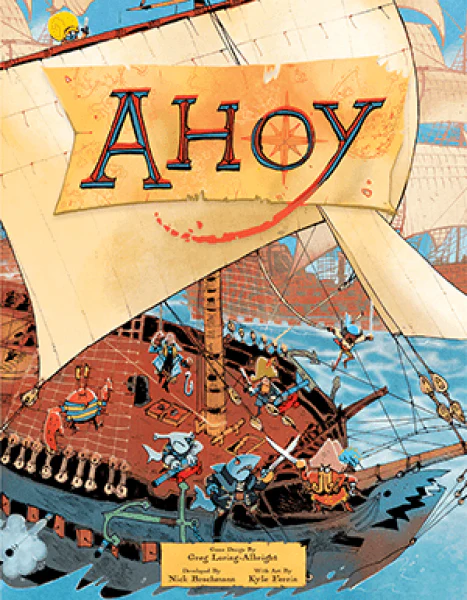
Ahoy
Ahoy is a lightly asymmetrical game where two to four players take the roles of swashbucklers and soldiers seeking Fame on the high seas. One player controls the Bluefin Squadron, a company of sharks and their toothy friends, who patrol these waters and keep order with shot and sword. Another player controls the Mollusk Union, an alliance of undersea creatures and their comrades-in-arms, who fight to reclaim their ancestral home. In games with more people, some players control Smugglers, maverick captains who run blockades to smuggle luxuries and essentials, delivering them to those with the most need—or the most coin. Explore the seas. As you play, you’ll make a unique map full of treasure troves, dangerous wreckage, and mighty sea currents, using deluxe double-layer region tiles. Featuring development from the same team that brought you Root and Oath, Ahoy offers deep, interactive gameplay in a fast-playing and easy-to-learn design with a colorful setting brought to life by Kyle Ferrin's gorgeous illustrations.
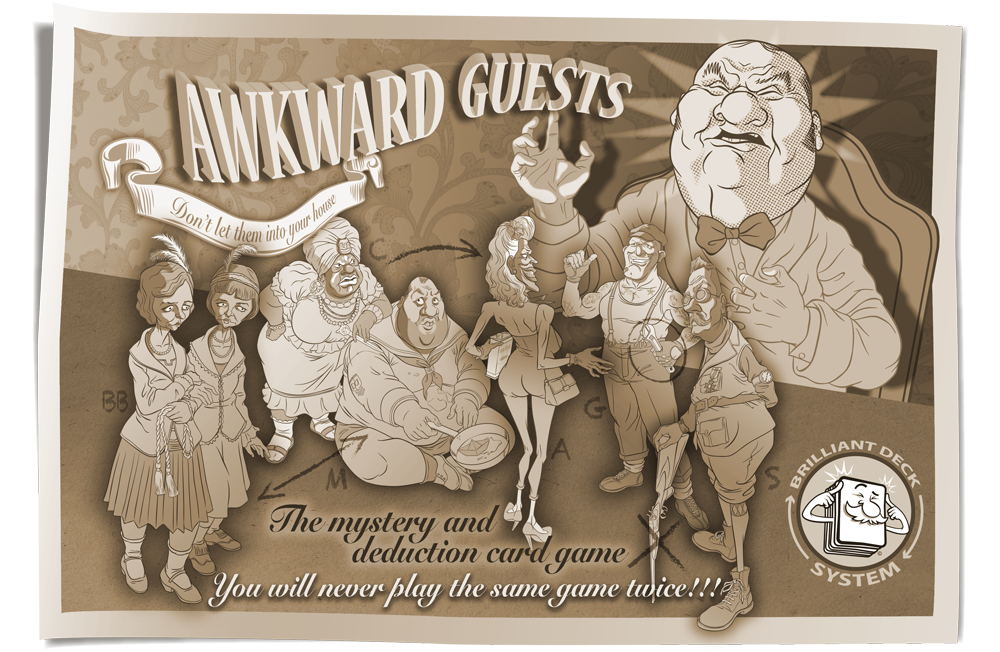
Awkward Guest: The Walton Case
Awkward Guests, a.k.a. Incómodos Invitados, is a one-of-a-kind deduction game with infinite re-playability. You can recreate Mr. Walton's murder in so many different ways that you won't ever play two similar games! (Mr. Walton will not thank you for doing this.) The game challenges you to use genuine detective abilities to solve each case. To solve a mystery, you have to interrogate the suspects, question the household staff, examine the crime scene, search for clues around the Walton Mansion, and consult the police reports. You will do all of this while exchanging information with your opponents or hiding it from them, so get ready to use all your gumshoe skills! WHO killed Mr. Walton? HOW did the murderer end his life? WHY did the murderer kill him? Was there an ACCOMPLICE? The heart of Awkward Guests is simple: Players have a hand of six cards, and each card has a value (1, 2 or 3 points, according to the amount of information that it provides) and several references (i.e., the subjects of the card information). During a turn, you ask for information about two different references in which you are interested. The rest of the players can offer you cards that contain the requested references, and you can trade for those cards by giving the offering players the same number of points they have offered via cards in your hand. After each round ends, players can try to solve the mystery. If the mystery is not solved, players discard part of their hands and receive three new cards. The player or players who solve the mystery first win.
Azul
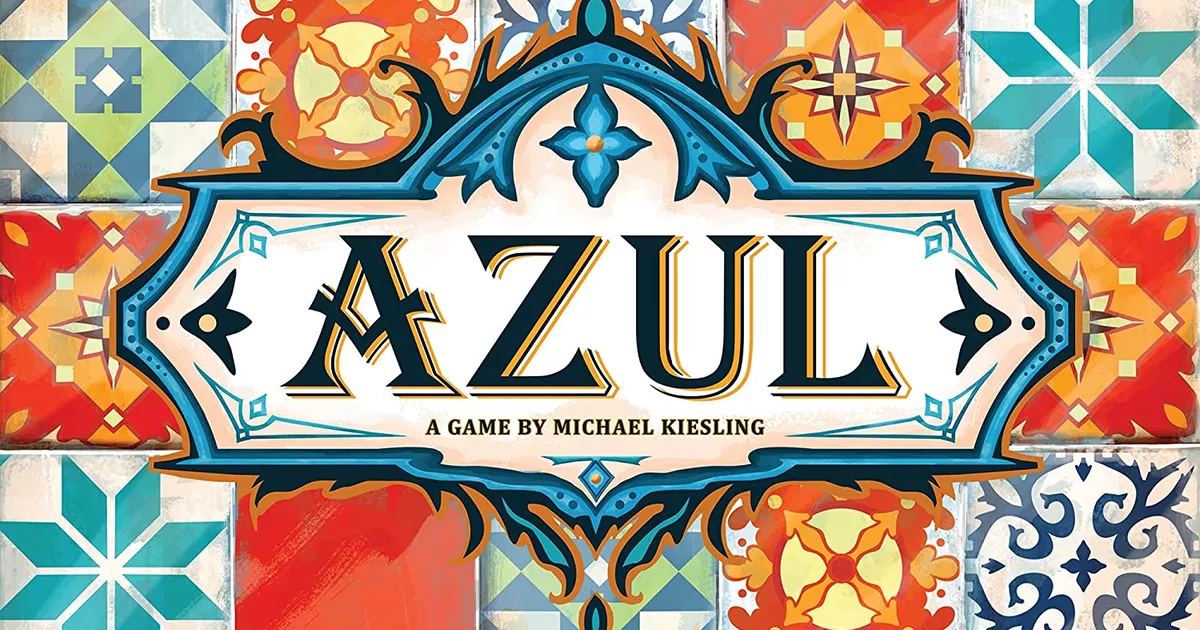
Introduced by the Moors, azulejos (originally white and blue ceramic tiles) were fully embraced by the Portuguese when their king Manuel I, on a visit to the Alhambra palace in Southern Spain, was mesmerized by the stunning beauty of the Moorish decorative tiles. The king, awestruck by the interior beauty of the Alhambra, immediately ordered that his own palace in Portugal be decorated with similar wall tiles. As a tile-laying artist, you have been challenged to embellish the walls of the Royal Palace of Evora. In the game Azul, players take turns drafting colored tiles from suppliers to their player board. Later in the round, players score points based on how they've placed their tiles to decorate the palace. Extra points are scored for specific patterns and completing sets; wasted supplies harm the player's score. The player with the most points at the end of the game wins.
Block Ness
The Block Ness monsters are finally sticking their heads out of the water...but it looks like the lake isn't big enough for everyone! In Block Ness, players take turns choosing a monster segment from their reserve and using it to increase the length of their creature on the Loch game board. Each new segment must be placed next to your monster's head or tail — with the head or tail piece then moving to the far side of the newly-placed piece — and you can cross the path of other monsters on the board only if you can go above them. Once all players are blocked or everyone has placed all of their segments (with the size of the game board changing depending on the number of players), whoever has the fewest segments remaining in their reserve wins. In case of a tie, the tied player whose monster head has the highest elevation wins.
Blood on the Clocktower
In the quiet village of Ravenswood Bluff, a demon walks amongst you. During a hellish thunderstorm, on the stroke of midnight, there echoes a bone-chilling scream. The townsfolk rush to investigate and find the town storyteller murdered, their body impaled on the hands of the clocktower, blood dripping onto the cobblestones below. A Demon is on the loose, murdering by night and disguised in human form by day. Some have scraps of information. Others have abilities that fight the evil or protect the innocent. But the Demon and its evil minions are spreading lies to confuse and breed suspicion. Will the good townsfolk put the puzzle together in time to execute the true demon and save themselves? Or will evil overrun this once peaceful village? Blood on the Clocktower is a bluffing game with players on opposing teams of Good and Evil, overseen by a Storyteller player who conducts the action and makes crucial decisions. The goal of the game is to successfully deduce and execute the demons before they outnumber the townfolk. During a 'day' phase players socialize openly and whisper privately to trade knowledge or spread lies, culminating in a player's execution if a majority suspects them of being Evil. During a 'night' time, players close their eyes and are woken one at a time by the Storyteller to gather information, spread mischief, or kill. The Storyteller uses the game's intricate playing pieces to guide each game, leaving others free to play without a table or board. Players stay in the thick of the action to the very end even if their characters are killed, haunting Ravenswood Bluff as ghosts trying to win from beyond the grave. If you arrive late to a game, you can enter after it's started as a powerful Traveller character with unusual talents and questionable allegiances. Each character comes with their own special ability and no two players in a game are ever the same character.
Ca$h n Guns: Second Edition
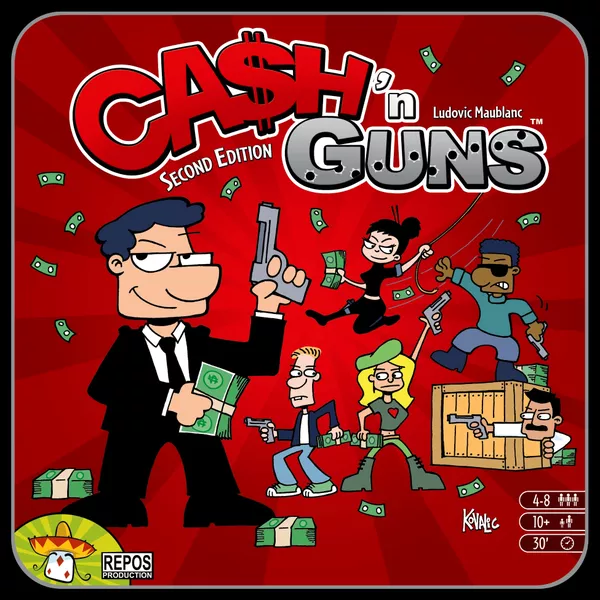
In an abandoned warehouse a gangster band is splitting its loot, but they can't agree on the split! It's time to let the guns talk and soon everyone is aiming at everyone. The richest surviving gangster wins the game! Ca$h 'n Guns helps you relive the best scenes of your favorite gangster movies. The goal is to have more money than anyone else after eight rounds while still being alive. Each round, one player is the Boss, and he controls the pace of play. First, loot cards are revealed on the table to show what's up for grabs. Next, players load their guns by secretly selecting either a "Bang!" or a "Click! Click!" card from their hand. The Boss counts to three, and on "Three" each player points his foam gun at someone else; due to his status, the Boss can tell one player who's pointing a gun at him that he needs to point it in another direction. After a pause to observe threats and measure the seriousness in an opponent's eyes, the Boss counts to three again and anyone who doesn't want to risk getting shot can chicken out and remove themselves from the round. Everyone who's pointing a gun at someone still in the round now reveals their card, and anyone who's the target of a "Bang!" takes a wound marker and gets none of the available loot. Starting with the Boss, everyone still in the round takes one loot card at a time from the table — money, diamonds, paintings, the position of Boss, medical care (to remove a wound), or a new bullet (to add a "Bang!" card to your hand) — until everything has been claimed. After eight rounds, the game ends. Whoever has the most diamonds receives a big bonus, and paintings score based on the number of them that you've collected. Whoever has the most valuable stash wins!

Camel Up: Second Edition
In Camel Up, up to eight players bet on five racing camels, trying to suss out which will place first and second in a quick race around a pyramid. The earlier you place your bet, the more you can win — should you guess correctly, of course. Camels don't run neatly, however, sometimes landing on top of another one and being carried toward the finish line. Who's going to run when? That all depends on how the dice come out of the pyramid dice shaker, which releases one die at a time when players pause from their bets long enough to see who's actually moving! Players roll all 5 dice to setup the start positions of the camels. On each leg, players pick one betting card for each color camel, showing how many coins they will win/lose, depending on the camel's position after the leg. The dice are then rolled in the pyramid dice roller, which allows one die to come out at a time and moves the matching color camel. Players can also place oasis cards to earn extra coins. After all 5 camels are moved, bets are resolved and a new leg start. Play continues until a camel passes the finish line. Once a camel crossess the finish line, all end of race bets are resolved and the player with the most coins wins.
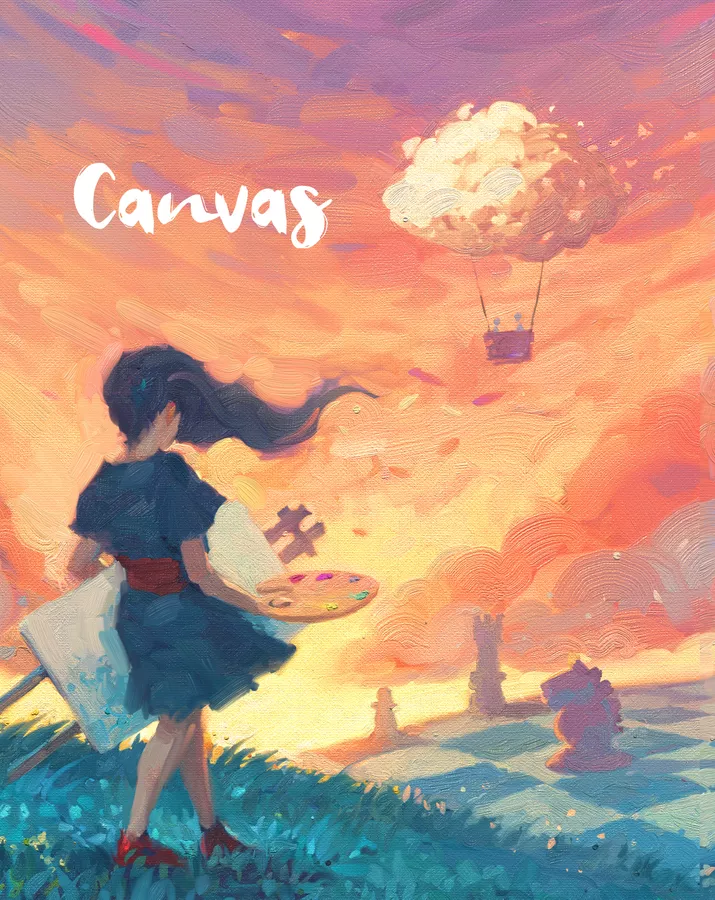
Canvas
In Canvas, you play as a painter competing in an art competition. Players will collect art cards, layering 3 of them together to create their own unique Painting. Each card contains a piece of artwork as well as a set of icons used during scoring. Icons will be revealed or hidden based on the way players choose to layer the cards making for an exciting puzzle. Paintings are scored based on a set of Scoring cards which will change each game. Once players have created and scored 3 paintings the game ends. On your turn you may take an Art card or make a painting. Art cards are selected from a row of cards in the center of play. Each of these cards has a cost associated with their position. After selecting an Art card you must pay its cost by placing an Inspiration token on each of the cards to its left. If you do not have enough Inspiration tokens, you may not select that card. Any tokens on the card you have selected are kept for future turns. The far left card costs no Inspiration tokens to take. If you have three or more Art cards you may choose to make a painting. Select 3 of your art cards, arrange them in any order and then score them by comparing the visible icons on your painting to the Scoring conditions. Once all players have made 3 paintings the game ends. The player with the most points wins!
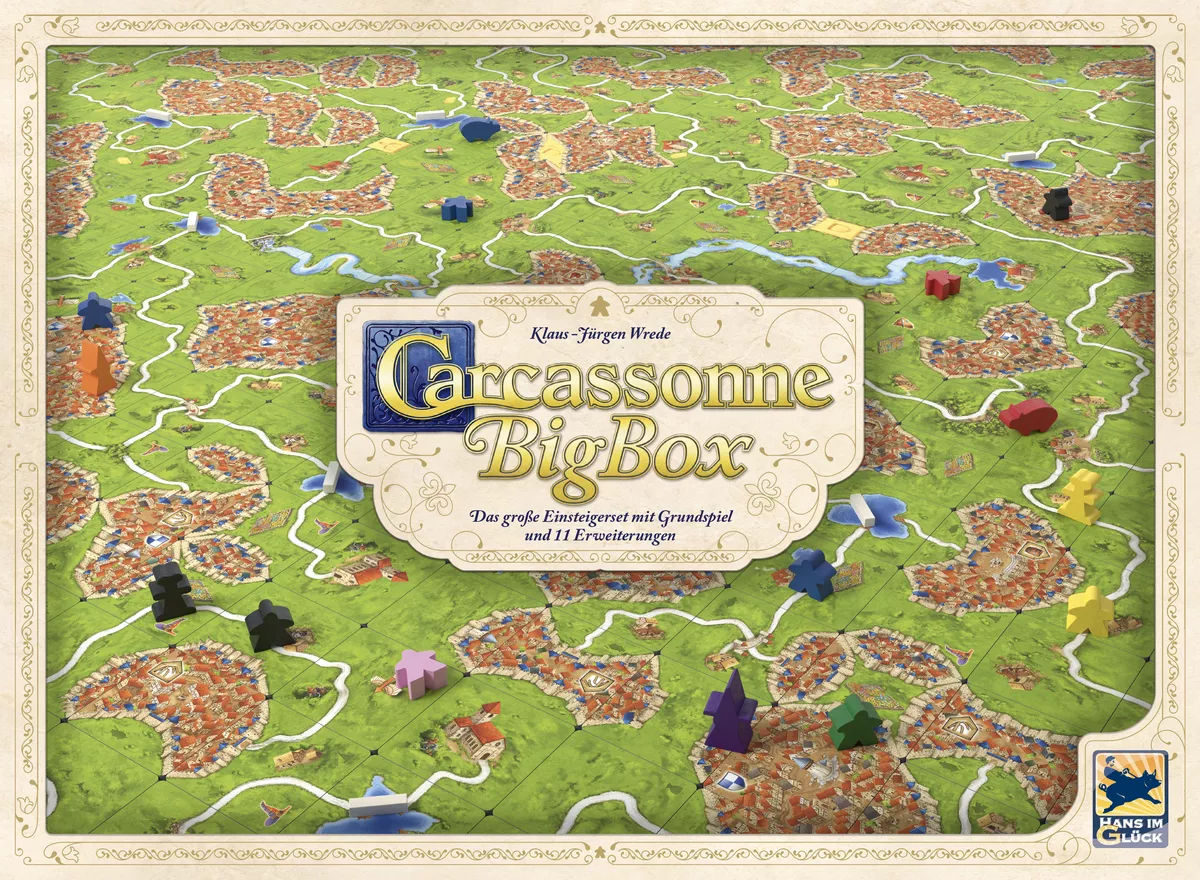
Carcassonne Big Box
Carcassonne is a tile placement game in which the players draw and place a tile with a piece of southern French landscape represented on it. The tile might feature a city, a road, a cloister, grassland or some combination thereof, and it must be placed adjacent to tiles that have already been played, in such a way that cities are connected to cities, roads to roads, et cetera. Having placed a tile, the player can then decide to place one of their meeples in one of the areas on it: in the city as a knight, on the road as a robber, in the cloister as a monk, or in the field as a farmer. When that area is complete that meeple scores points for its owner. During a game of Carcassonne, players are faced with decisions like: "Is it really worth putting my last meeple there?" or "Should I use this tile to expand my city, or should I place it near my opponent instead, thus making it a harder for them to complete it and score points?" Since players place only one tile and have the option to place one meeple on it, turns proceed quickly even if it is a game full of options and possibilities.
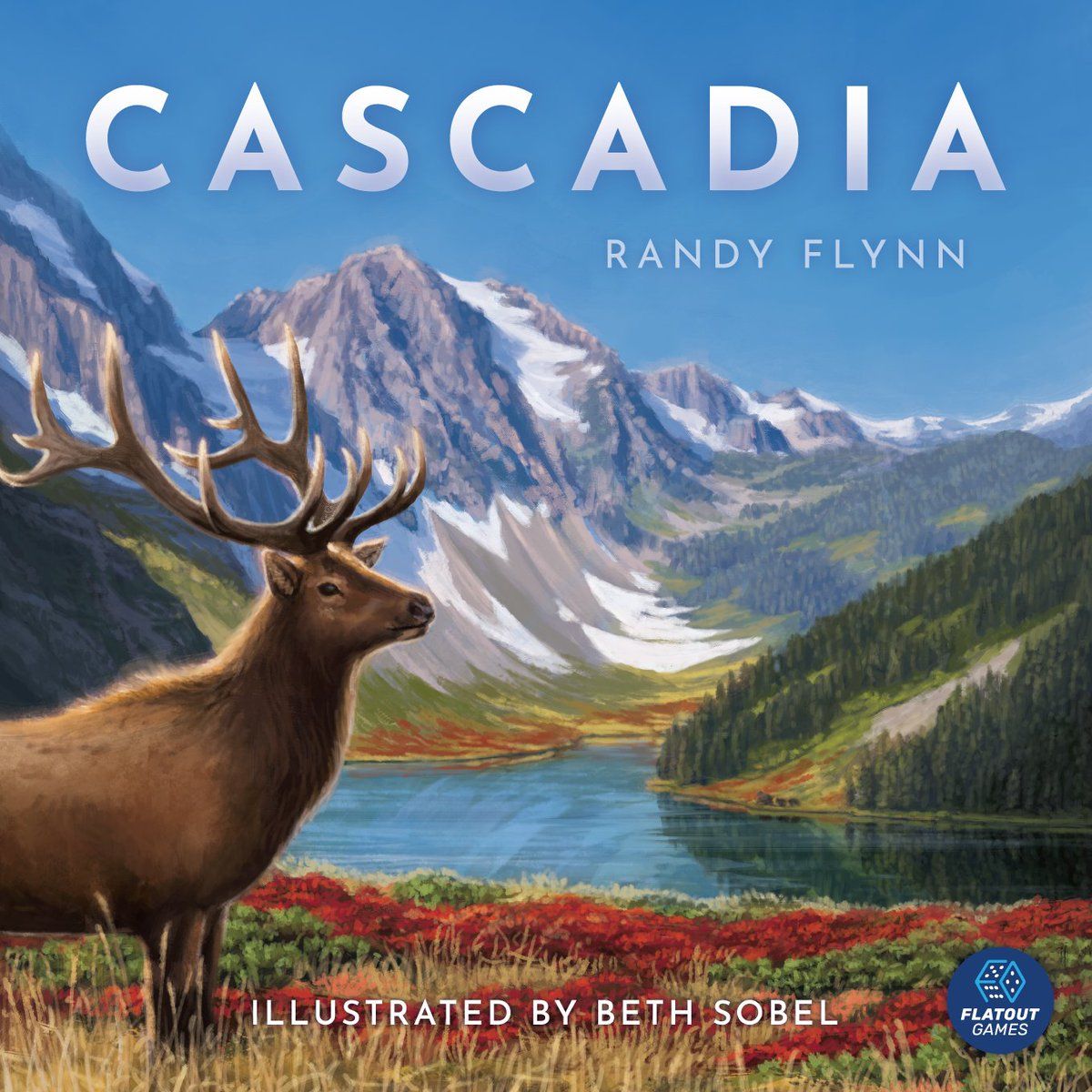
Cascadia
Cascadia is a puzzly tile-laying and token-drafting game featuring the habitats and wildlife of the Pacific Northwest. In the game, you take turns building out your own terrain area and populating it with wildlife. You start with three hexagonal habitat tiles (with the five types of habitat in the game), and on a turn you choose a new habitat tile that's paired with a wildlife token, then place that tile next to your other ones and place the wildlife token on an appropriate habitat. (Each tile depicts 1-3 types of wildlife from the five types in the game, and you can place at most one token on a habitat.) Four tiles are on display, with each tile being paired at random with a wildlife token, so you must make the best of what's available — unless you have a nature token to spend so that you can pick your choice of each item. Ideally you can place habitat tiles to create matching terrain that reduces fragmentation and creates wildlife corridors, mostly because you score for the largest area of each type of habitat at game's end, with a bonus if your group is larger than each other player's. At the same time, you want to place wildlife tokens so that you can maximize the number of points scored by them, with the wildlife goals being determined at random by one of the four scoring cards for each type of wildlife. Maybe hawks want to be separate from other hawks, while foxes want lots of different animals surrounding them and bears want to be in pairs. Can you make it happen?